On the Ethics of Tourism
Writer • Reporter • Researcher • Photographer
Independent Reporting
Global
2023 - Present (Ongoing)
On the Ethics of Tourism is an ongoing reporting project examining one of the defining questions facing the global travel industry: can tourism become a force for environmental restoration, cultural preservation, and community resilience rather than simply minimizing harm?
Combining field reporting, long-form writing, photography, and interviews with tourism leaders, conservationists, hoteliers, researchers, and local communities, the project explores the growing movement toward regenerative travel and the complex relationship between tourism, climate change, economic development, and cultural identity.
Reporting has taken me from the villages of Morocco's High Atlas Mountains to conversations with global leaders in sustainable tourism, uncovering the ways destinations are attempting to balance environmental stewardship, community wellbeing, and economic opportunity. Along the way, the project examines both the promises and contradictions of an industry capable of protecting the very places it also places at risk.
As the conversation around responsible tourism continues to evolve, this project remains an ongoing body of reporting documenting how destinations, businesses, and travelers are redefining what ethical travel can look like in practice.

Lalla Fatima’s home is nestled into a slope in the dusty red hills of the Ourika Valley, beneath the High Atlas Mountains, about an hour outside of Marrakech. The mud brick walls peek from behind the haphazard branches of walnut trees. The Ourika River murmurs just out of sight. The central courtyard is a jostling cacophony–dozens of skittering chickens, a ragged gray donkey, a stocky mutt, and a pair of girls of maybe six or seven hurrying to inspect the visitors.
We are ushered through a corridor, past a narrow kitchen where an earthenware wood-fired oven crackles in a patch of slanted sunlight, and into a sunken gathering space. The room is bright with dappled sun that streams through the hand-woven reed roof. Benches that are built directly into the walls are lined for comfort with orange and red embroidered cushions, and tables are set with mismatched tablecloths.
At the far wall, in a floral top and black headscarf, sits Lalla Fatima contentedly keeping watch over her domain. A patient smile plays at her lips as she waits. Silently, her daughters and granddaughters float from the kitchen and back to bring her what she needs.
On each table, protected from the flies by plastic wrap, breakfast awaits.
There are many valid criticisms of tourism. It can cause or exacerbate environmental damage, lead to the commercialization of cultures, create a service-based economy with little opportunity for advancement, drive up living costs, and make local communities resentful. Beyond all that, a 2018 study published in Nature Climate Change estimated that the global tourism industry contributes to 8% of global greenhouse gas emissions.
But tourism can also be beneficial. In 2022, tourism contributed 7.6% to global GDP, according to the World Travel and Tourism Council (WTTC). Multiple studies have shown that tourism can reduce inequality, create job opportunities, incentivize investments in infrastructure, help protect the environment, and promote cultural awareness for locals and tourists alike.
So tourism is a double-edged sword.
International tourism has bounced back from the pandemic and shows little sign of slowing. In fact, the annual number of air passengers is predicted to more than double by 2050, according to the International Civil Aviation Organization. Most of these tourists, some 69%, say they want sustainable travel options, according to the WTTC. As overtourism plagues destinations, and as climate change reshapes the world we live in, the industry is grappling with its next iteration.
Travelers are rethinking how, where, and, most importantly, why they travel. For some who feel that sustainable is a low bar, a concept called “regenerative travel” looks to harness the power of tourism to make the world a better place.
The philosophy of regenerative travel is simple: Leave the world a little better than you found it. It’s a step beyond sustainability. Sustainable travel seeks to do no harm. Regenerative travel seeks renewal and improvement. It adds meaningful value to a destination, enhancing the ecosystem, cultivating community, and preserving cultural heritage.
In turn, regenerative travelers gain a deeper, more immersive understanding of the places they visit–experiences often more rewarding than checking out typical tourist attractions.
“Regenerative travel,” explains Amanda Ho, co-founder of Regenerative Travel, a network of key travel stakeholders with a shared vision of travel as a force for good, “is the commitment of a steward to regenerate, renew, and restore the ecosystem and community.”
“Everybody's in a different stage of their sustainability journey and their understanding of what it means to be a conscious or responsible traveler,” says Javier Arredondo, the Vice President of Sustainability at Virtuoso, a global network of agencies specializing in luxury and experiential travel, known for their commitment to sustainability.
“It's this journey of thinking a little bit more every time you make a decision,” he says. From deciding where you go, where you stay, what you do, if you arrive by bus or plane or train, how you treat people, which questions you ask--it all matters.
“I love it when it's well done, when it's well understood. But I hate it when people are like, ‘Oh, I'm regenerative just because it sounds nice, sustainability is boring. I'll just use this new term,’” says Arredondo. “So I really worry there's a lot of greenwashing around this term.”
The hope for regenerative travel, he says, is that by making travelers and tour operators, hoteliers, travel agents, the whole gamut, more conscious of their impact, tourism will continue to adapt in a positive direction. It’s not a goal, but a set of values.
“Regeneration is a process. It's not something you achieve,” he says. “It's something you do throughout your life.”
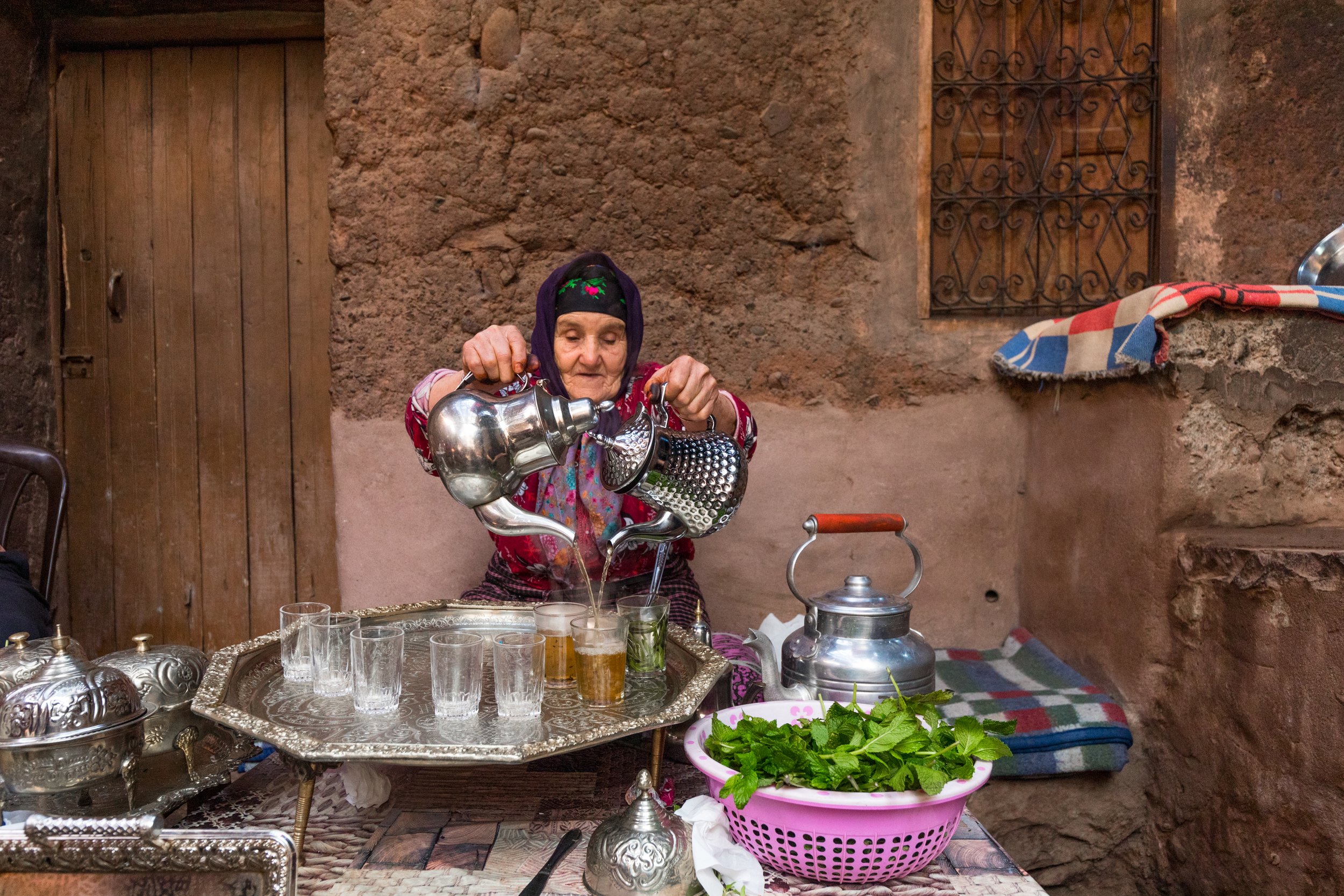
An etched silver octagonal tray is set on the table in front of Lalla Fatima, with two silver teapots and a handful of tea glasses. In the medina of Marrakech, hundreds of these intricate silver tea sets line shelves for sale, though I can’t help but wonder how they’d fit into an overstuffed suitcase. Next comes a strainer with fresh mint from the garden, a pouch of gunpowder green tea, and a silver tureen filled with chunks of sugar.
In an Amazigh dialect translated by our guide, Lalla Fatima proudly explains the process so familiar to every Moroccan household: making a pot of Moroccan mint tea. As the eldest, wisest woman in her family, the responsibility and honor falls to her deft, wrinkled hands.
She tears the stalks of mint, measures out the green tea by sight, and throws in enough sugar to take up half the pot. Then she fills each pot with boiling water straight from the kitchen fire and lets the tea brew. Before she can serve it, she fills a glass and empties it back into the pot, repeating several times to mix it thoroughly. Finally, she stands so that she can pour the tea from high above each glass in a precise arc, in order to create a froth which improves the flavor. This ritual is an art passed down from generation to generation. Mint tea, a sign of hospitality and respect, is at the heart of everything in Morocco.
Lalla Fatima’s family has lived in this place for generations, cultivating all they need on a few acres. But alongside the deep-rooted traditions that define Morocco’s rich culture–like the hospitable pot of tea served to guests–the outside world has steadily encroached. Environmental concerns threaten those who rely on the land and modernization puts local culture at risk. Families like Lalla Fatima’s are finding a creative way to keep up, merging their agrarian or nomadic lifestyle into the burgeoning tourism industry. They are proud of their heritage and, by offering meals and tours to tourists, are able to share that with the world, and to make a small income in the process.
Throughout history, humans have harbored a propensity to travel. Nomadic tribes ventured across thousands of miles, explorers set sail throughout the world driven by trade and curiosity, the development of empires allowed for widespread movement with a common language and currency, and frontiers were constantly expanded, borders redrawn.
“What was it like when we used to travel a long time ago before mass tourism?” asks David Leventhal, co-founder of Regenerative Travel and the owner of Playa Viva, a regenerative resort on the Pacific coast of Mexico. “We would break bread and share whatever their food was. We would eat what is local and we would share stories. They would say, ‘Where are you from? Tell us what life is like.’ And you would find out about what life is like where they're from. That's reciprocity, that's local, that's low impact. That's arriving with gifts and leaving. Giving more than what you took. Travel just turned around.”
Mass tourism, in fundamental ways, misses the point of travel.
It’s something that many in the industry are thinking about.
“Especially young girls just need to know what's out there for them, what's possible,” says Fadoua Atif, the founder of Women Best Travel and the Moroccan travel agent who arranged the visit to Lalla Fatima’s. Less than 4% of Morocco’s tour guides are women and it’s considered unusual for women to work in roles outside of the home or office.
Atif’s journey began with her own love of travel. After graduating from university in 2017, she started couch surfing and meeting other travelers, many of whom were women who expressed concerns they’d had about Morocco before coming. This inspired Atif to start a tour company with a focus of helping women in the travel industry, making it a priority to work only with local and women-owned businesses.
At first, she says, as a female entrepreneur and guide it was difficult for her to be taken seriously. She would call vendors and be asked, “Who is your boss?” Or when leading groups she’d be mistaken as one of the tourists. Even her family struggled to understand in the beginning.
But she has also seen the ways that tourism can inspire and empower women.
“It's helped them get a source of income,” she says, “which helped them be independent and maybe pursue their careers or continue their education.”
I thought of the two girls, Lalla Fatima’s granddaughters, who had lingered wide-eyed and giggling during our visit. They were seeing, through their mothers and grandmother, through a female tour guide, and in the many frequent guests, a world of opportunity for women.
Nicole Robinson, the Chief Marketing Officer of andBeyond, an award-winning luxury experiential travel company offering tours in Africa, Asia, and South America, tells a similar story about a girl in Kenya who was raised in a traditional Maasai family, a culture of nomadic pastoralists in East Africa in which most girls are married very young and given little freedom or education. This girl was able to attend a school built by an andBeyond partner organization, Africa Foundation, where she witnessed a lesson about conservation led by a female guide. It was the first time she’d ever seen a female guide. So when the girl finished school, she joined a mentoring program with andBeyond and became a naturalist at the lodge. And though it was difficult for her, she has remained in all ways authentically Maasai, connected to her culture but changed in what she thought was possible for her.
“The most fulfilling travel experience you can have,” says Amanda Ho, “is talking to people. Meeting a local person, having an exchange, and understanding what their lives are like.”
Travel is “a way for us to connect with people who are different than us,” says Jared Meyers, who is the chairman of Legacy Vacation Resorts, the vice chairman and co-founder of Climate First Bank, and co-founder of B Tourism and Florida for Good. We’re led to believe that those who think differently than us have ulterior motives, he says, but that is rarely the case. If we're only focused on the few differences, we can’t appreciate the many similarities.
That’s why he’s especially concerned about tourism’s impact on the environment. The lessons that travel can facilitate are unlikely to happen on a video chat, he says. “I think that it does take spending some real time with people in environments, having a meal with them, having them educate us a little bit on why their culture is as it is, and then you just appreciate it in different ways instead of just thinking we know it all.”
One reason that travel is an especially powerful educator, Meyers believes, is because of the time and space it gives people outside of daily routines. “We're all generally stressed in our day-to-day world,” he says. We often don’t have time to read, learn or consider new ideas. But, “in vacation mode, you're more open to learning.”
Sometimes, though, the effect of tourism is harder to explain.
One of Robinson’s favorite regenerative travel memories is standing with her kids on a South African beach, just north of Durban, watching a huge leatherback turtle drag herself up the sand to lay eggs. “It’s like you’re watching a National Geographic piece of content,” she says, but live. “You can’t look at the world the same way.”
Then, several years later on an island just off Zanzibar, in Tanzania, Robinson witnessed baby turtles hatch and race to the ocean. “I've been privileged,” she says, “to see both sides of that experience. And, you know, I’m not the same afterwards. I mean, it is a truly happy moment where the rest of the world seems so far away, but everything feels right. I don't know how to explain it, but it just feels like this is how it should be.”
Likewise at Playa Viva, the resort that Leventhal operates in Mexico, visitors are given the opportunity to help newly-hatched baby turtles reach the ocean at the La Tortuga Viva Sanctuary. A number of beachfront resorts offer similar programs as part of efforts to save endangered sea turtle populations that nest along their shores.
When you do it for the first time, says Leventhal, it is “a truly life-changing experience.” But for local guides who have watched those tiny flippers shuffling in the sand a thousand times, it can start to feel quotidian. Yet seeing the awed reactions of visitors can be a meaningful reminder that this is actually really special.
“When you make somebody feel like their home, their place, their environment is special,” says Leventhal, “that level of reciprocity is so important.”
A little white donkey stands by the side of the road, draped in a blue padded saddle almost bigger than his body. In the shallow valley beyond, clusters of bright white almond trees have just begun to bloom, the buds a contrast to the reddish gray of the village and mountains beyond. The earthy scent of wet clay wafts on the breeze.
I’ve long since given up trying to keep my formerly white sneakers clean in this landscape, so I pick my way through brambles to greet the donkey with a quiet salaam alaikum, the standard greeting in Morocco. He glances at me sideways. Every day he carries tourists up and down the steep mountain passes beneath Toubkal, the tallest peak in North Africa; he’s totally aloof.
I soon find myself atop one of his kin weaving up a switchback path. I am assured this is the most efficient way to reach the kasbah. I don’t mind as I take in the views and the quiet patter of rocks under hooves. About 20 minutes later the man leading my donkey stops in front of a cluster of buildings and I slide down. Saying something in Arabic, or maybe a local dialect, he gestures for me to enter through a gate and he slowly departs. I guess this is the place.
I pass through a well-tended garden, several rug-draped sitting rooms, and up a rickety spiral staircase before arriving at the upper terrace where I am to eat my lunch. Couscous and vegetable tagine arrive teeming with produce grown in the garden below. The bread, I am told, has been baked by a local woman. The village of Imlil, with its terraced orchards, and views of the snow-flecked Mount Toubkal, are laid out before us in a complete 360-degree panorama. There’s a hazy sense, evocatively Moroccan, that I’ve stepped outside of time.
It’s only as I’m leaving that I notice a placard at the entrance etched with a quote:
“Dreams are only the plans of the reasonable.”
The Kasbah du Toubkal was renovated from the ruins of an old kasbah–originally the summer home of a local caïd, or chief–by two British brothers, Mike and Chris McHugo. Mike had fallen in love with Morocco in 1972 while driving himself around in an old Volkswagen Beetle, so he set up the tour company that eventually became Discover Ltd., which runs educational tours in Morocco and southern France. Then, during a visit to Imlil in 1989, the brothers eyed the neglected ruins of the kasbah looming over the village and they decided to make the investment.
Before they began, they outlined their vision: “to be a flagship development for sustainable tourism in a fragile mountain environment; to contribute to the enhancement, viability and vitality of the local community; to generate a change of attitude in our guests through exposure to something different,” and more.
Designed using local materials by traditional craftsmen and fully staffed by members of the local population, the kasbah opened as a hotel in 1995. It has since won numerous awards and made a name in the responsible tourism space.
“Before people knew about ‘sustainable tourism’ and all these words–‘regenerative travel’ is the latest—we really got started by just being good neighbors,” says Mike McHugo.
The kasbah’s values exemplify best practices in the industry. McHugo says he was once asked by a reporter where he got such strong values from, a question he struggled to answer.
“I don't view anything we've done as particularly amazing,” says McHugo. “If you want to be a good neighbor and not destroy the environment, you end up doing the things that we've done.”
What he is most proud of, he says, is the work of Education for All, a charity he helped to start. A five percent fee on every invoice at the kasbah helps to fund the organization, which helps girls from rural villages to receive an education, among other projects.
Few girls from the rural communities of the High Atlas Mountains get to continue their education past primary school, usually because secondary schools are far away in larger towns. Education for All builds and runs boarding houses for girls ages 12-18 at no cost to their families, providing everything they need from meals to study support.
“When the first house was opened,” recalls McHugo, “the local governor said, ‘You won't be aware of your greatest influence because your greatest influence will be changing the mentality of the people in the rural villages.’”
Today, the organization runs six boarding houses and has helped educate hundreds of girls.
The values that shape regenerative travel are not new, though the term may be. There are innumerable hotels, travel agents, tour operators, and more, throughout the world that, like the Kasbah du Toubkal, have long operated with a goal of doing more good than harm. For andBeyond, it’s been a core tenet from the beginning, according to Robinson. “It’s the foundation of why we are all here.”
Arredondo, of Virtuoso, feels the travel industry has a huge responsibility, one which many are only just starting to appreciate. “We need to educate everybody. We need to educate the industry. We need to educate the consumer. Because not everybody is having this conversation yet.”
There is a particular shade of blue that occurs when ice is so compacted, so compressed under the weight of hundreds of thousands of years, that the air bubbles are squeezed out of it and it takes on the properties of a mineral. This turquoise color is so vivid that it appears, somehow, unnatural. Like a neon sign hovering over a rural diner off the interstate, it seems to glow from within.
The first time I saw the blue of a glacier up close, I was taken aback. Though it was the height of summer in Patagonia, it was brisk, and patches of white snow on the rocks to either side of the Serrano Glacier only further emphasized the strange aqua-blue mass. I’d always assumed that glaciers are white—or, more accurately, I hadn’t really thought about the color of glaciers at all.
But more jarring than that shade of blue was the information related by our guide.
That morning, we’d boarded a ferry-style tour boat in Puerto Natales which had bobbed its way through the Seno de Última Esperanza, or ‘Last Hope Sound.’ The Serrano Glacier was the last stop on the tour and the only time we stepped off the boat. It would deposit us about a 20-minute hike from the view of the glacier, we were told, so some of the older folks chose not to go.
The trail curved through the pines around an oblong lagoon that was oddly disconnected from the main body of water beyond. I briefly wondered why they didn’t just build a connection between the two so we could have sailed right up to the foot of the glacier.
That innocuous thought soon turned to guilty horror. As our group gazed at the glacier, snapping photos from the designated viewpoint, the guide explained that the disjointed “lagoon” we’d circumnavigated was actually the rapidly melting remnant of the glacier itself.
As recently as the 1980s, the glacier had reached well into the sea where our boat awaited. But by 2019, when I was there, the glacier was receding by 10 to 20 meters a year. “The glaciers in this region are changing rapidly,” says Eric Rignot, a glaciologist at NASA’s Jet Propulsion Laboratory and the University of California-Irvine, in a 2018 feature. “They are, in fact, melting away at some of the highest rates on the planet.”
The guide had brought along printed photos showing the glacier’s ominously rapid retreat. He pointed out that the markers along the trail, which I’d assumed were measures of distance, were labeled with years to show where the edge of the glacier had been at that time.
Something shifted in everyone’s manner as we reassessed what was occurring, it seemed, before our very eyes. The sooty tinge that covered parts of that beautiful blue, and the forlorn chunks floating away in the gray-green water, took on sad significance. My throat was tight on the trek back to the boat. I stopped frequently to glance back at the magnificent glacier and at the markers that, every few steps, designated its disappearance.
I have since reflected on that experience–which couldn’t have lasted more than an hour or two–with the friends I’d been traveling with. Though I am the only one in the group who would describe myself as an environmentalist, we all remember that glacier so starkly. There was something painful about witnessing the nature we love deteriorating, up close. And to know that we, humans, are the cause.
That is one of the things that makes travel so powerful–seeing something first hand can make a lasting connection that no amount of writing, photos, videos, graphs, or speeches can replicate. Of course I’d known in a vague way that glaciers were melting; we are told this all the time. But it was only when I saw it with my own eyes that I really felt their loss.
And yet the very travel–by plane, by car, and by boat–that had allowed us to visit that glacier was contributing to its destruction.
“Generally tourism is not operated in a way that enhances a community. It exploits, even if not intentionally,” says Meyers, of Legacy Vacation Resorts and B Tourism. “I do think tourism is a wonderful industry,” he says, “and I think that when conducted properly it has huge, huge benefits. But there is going to continue to be a real tension with where we are with climate change and for people to be flying all around the world for tourism.”
Ancient glaciers are melting, coral reefs are dying, forests are burning to ash or being cleared for livestock, and entire islands are disappearing under a rising sea. Climate change is changing the very things that have made many places popular destinations.
“For decades people were used to summering in Europe,” says Arredondo. “Now it's unbearable, more than 40 Celsius. And you don't want to go skiing if there is no snow.”
Travelers’ habits are changing in response. The wealthiest are changing their plans. Too hot in Antibes? No snow in St. Moritz? No problem, they’ll go elsewhere. Many are changing the timing of their trips, throwing established ‘tourist seasons’ further and further into disarray. In many places, mass tourism is cannibalizing itself by destroying the very resources it relies upon: nature, culture, and people. It's one of the unusual industries that sells something that it does not own.
Some are capitalizing on disappearing resources while they still can. So-called ‘last-chance tourism’ describes the desire to visit vanishing destinations.
“For thousands of years, humans have raced to be the first to scale a peak, cross a frontier, or document a new species or landscape,” writes Paige McClanahan in a piece for The New York Times. “Now, in some cases, we’re racing to be the last.”
“I'm so uncomfortable with that,” says Arredondo with a grimace. “But yes, it is happening. And many, many, many people think like that.”
At its best, some studies show that tourism can lead to meaningful shifts in behavior and inspire visitors to take action. Typical mass tourism, however, only accelerates environmental collapse.
“It would be wrong to stop development,” says McHugo, “so we tried to think we could perhaps influence the development so that it was slightly more forward thinking, to avoid the worst mistakes that tourism brings.”
“The only reason the Serengeti has not been turned into cattle ranches is because people show up to see it,” said Costas Crist, a sustainable tourism expert and award-winning editor, at a 2023 Climate Week panel hosted by &Beyond in New York City.
Conservation, studies show, is most successful when it actively involves the communities that it serves. “Anything that is done with community should be done with communities,” says Robinson. It may take more time, but it’s important to understand what a community actually needs rather than assuming or doing something just because “it makes you feel good.”
“Just because you put a fence around an area doesn't mean it's protected,” says Leventhal, Regenerative Travel co-founder. “You’ve got to work on the people problems first.”
It’s a precarious balance between keeping people out and letting people in—between preserving the natural environment and welcoming the kind of tourism that acts as protector and educator. Communities that rely on tourism revenue, especially those in endangered environments, are under increasing pressure to find that balance.
“To be a force for good, it really means that all stakeholders–all those that are impacted by what you do–are elevated in some positive way,” says Meyers.
“There are things that we can do that actually restore and repair harm that's caused by our operations,” he says. The potential to do good will vary in each place in the world, but beyond just reducing emissions or cutting plastics, resorts can do things like protect biodiversity or involve charities to foster community involvement.
What happens when the community turns against tourism? In addition to the general annoyance of crowded streets, overtourism pollutes the environment, overburdens local infrastructure, drives up the costs of living, and leads to the resentment of locals.
Venice is often cited as the prime example of this phenomenon. Its precarious position makes it notoriously vulnerable to rising sea levels, but despite continued efforts to curb visitors, millions of people flood into the city each year. Tourists want to visit before the city is gone forever. Some locals want to make the most of the opportunity now and face the inevitable later.
In contrast to this kind of short-term thinking, proponents of regenerative travel want to save tourism from itself. It starts, they say, by looking at what went wrong.
Businesses were originally created to solve problems, not create them, says Meyers. “I think that a business license bestows that responsibility.” Unfortunately, few businesses practice that way.
Some companies integrate regeneration into everything they do.
Messaging isn’t just done in words, Meyers says, but in each point of an experience. For example, Legacy Vacation Resorts has moved from single-use plastic room keys to bamboo or paper keys at check-in. On the back of each key, the staff prints the estimated carbon emissions that will be generated from the stay and the number of trees they will plant to offset those emissions.
“We use that as a learning element,” Meyers says. “So that hopefully a guest looks at it and says, ‘What does this mean?’ It's such a great conversational opportunity. And we tell them, we take care of it for you. We're planting those trees. So it's not like you should feel guilty that you traveled and you need to go do something about it. They learn that we're doing this for them. It's a very friendly way. Hopefully when they leave they're like, ‘I should look into this and maybe I should measure my own personal footprint.’”
Whatever part of the industry you're in, says Arredondo, of Virtuoso, there are examples to look at, both good and ugly. There have been many mistakes, but people in the travel industry can learn from those. There have also been and continue to be successes.
“We considered ourselves regenerative at the beginning,” says Robinson, of andBeyond. “How are we different now from 50 years ago? I think you can't ever say that you’re finished. We are always learning and there's always insights. The way we looked at something ten years ago is different to the way we look now. The intent is the same. We just know now what we didn't know and so we're doing better things now. But the intent is still regeneration.”
On September 8, 2023, following a lively dinner with some guests and a few bottles of wine, Mike McHugo and his older brother retired to their bedrooms at the Kasbah du Toubkal and fell quickly asleep. At approximately 11:11 P.M. local time, they were awakened by the shock of the ground oscillating beneath them. “I knew instantly,” says McHugo. He yelled for his brother to get on the floor and they waited, unsure how long the “shaking, whitewater rafting” sensation of the earthquake would last.
After about 10 seconds, he says, the motion subsided with “an almighty great big crash,” which he soon discovered was the sound of the main building crumbling. He grabbed a torch that he kept by his bedside and scrambled over rubble and up to the garden to assess the damage. Once he was sure that no one at the kasbah had been hurt, he sighed with relief. He and his guests were lucky, but the extent of the damage was immense.
The magnitude 6.8 earthquake killed over 3,000 people and left hundreds of thousands displaced, many of whom are still living in tents as they await assistance.
In the wake of the disaster, McHugo witnessed something remarkable. The weekend the earthquake struck coincided with the annual PURE Life Experiences travel show in Marrakech, a gathering of some of the most influential leaders in the tourism industry. Though the event was swiftly canceled, more than half of its attendees were already in Morocco. Everyone in town for the show, from the CEOs of luxury hotel groups to travel journalists, quickly mobilized relief efforts, setting up a warehouse for donations and generating major fundraising for local NGOs, including long-time PURE partner, Education for All.
“I realized that what I can do is get publicity for Education for All and to raise money,” says McHugo. “Post-earthquake we raised close to £1,000,000, which will be able to rebuild. We've effectively lost five of our six houses that will need rebuilding.”
The tourism industry also encouraged people to continue visiting, recognizing that the revenue would be crucial to recovery. Morocco proved its resilience in the face of the tragedy, and moved forward with events that had been scheduled to take place in Marrakech within a month of the disaster, including the International Monetary Fund and World Bank Annual Meetings.
“The last thing they needed was a second disaster called ‘no tourism at all,’” says McHugo.
Thus, despite the earthquake, Morocco set a new record of tourism arrivals in 2023, welcoming 14.5 million tourists, 1.3 million of whom arrived in December alone.
“It was like an experiment of what we could do, what impact we could have,” says Arredondo.
The direct impact of tourism extends well beyond emergency disaster relief. Tourism also creates opportunities in communities where there are otherwise few.
The Sahara Desert, for example, has expanded by about 10 percent since 1920, at least one-third of which, research from the U.S. National Science Foundation concluded, can be attributed to human-caused climate change.
For families who have lived in the desert areas of Morocco for generations, following water with their camels and finding work as they went, the effects of water scarcity and desertification can be devastating. Fadoua Atif, of Women Best Travel, says she knows hundreds of families like this.
“They wouldn't survive if it was not for tourism,” she says. “Now they are offering trekking tours and camping in the Sahara, and they have an income. They can support their families, their kids can go to school, and they don't have to leave their home.”
“Many people still think of development as the global north helping the global south,” says Arredondo. “But the travel industry has this power to jump through all that. There's no bureaucracy, there's no politics.”
A traveler can choose a resort based on that property’s work protecting its environment in tandem with the local community. Maybe they spend $1,000 a night to stay there. Then they book a $300 tour, and eat a $500 dinner at a locally-sourced restaurant. All of this money is being spent where it can actually go back into the community.
“You as a consumer have a direct capacity to go and spend your money or your time anywhere in the world where you want to have an impact,” Arredondo says.
How a consumer chooses to direct their impact can be complicated, especially with so much information to sift through. Unfortunately, greenwashing is commonplace in the travel industry, as it is in many others, and it can be hard to know which companies are truly making a positive impact. Most travelers do not have the time to assess every claim of sustainability. How can they know if they’re making a responsible choice?
Many in the industry are calling for more data and reporting, to start.
“There's such a lack of transparency in the industry in terms of what impact is being made,” says Amanda Ho, of Regenerative Travel. “It doesn't mean much anymore if you don't have the data. That is the biggest challenge and opportunity for the travel industry: to back up their claims with metrics.”
The EU Green Claims Directive, which could become enforceable by 2026, aims to reduce greenwashing by requiring that any environmental claims made by companies are substantiated with robust, verifiable methods. For the tourism industry, this means the goal is not just to do good, but to do so in measurable ways. Some organizations are struggling to do this; it may require an overhaul in how they do business.
At Virtuoso, for example, Arredondo wanted to understand the larger impact of the Virtuoso network. They had extensive data about where people are going, how long they stay, how much they spend. But he wanted to know what the environmental and social impacts were, too. So last year he conducted a survey of Virtuoso's more than 2,000 partners across more than 50 countries–a good representation of the industry as a whole.
Even with only a 9% response rate, the results of the survey were interesting. About 46% of the respondents said that travelers are changing their behavior in response to climate change, for example by selecting destinations where weather conditions are less extreme.
Arredondo was excited to see that the combined global amount of protected land managed by the respondents was 72,000 square kilometers–an area larger than Ireland.
“You think, ‘Oh, wow, we really are helping fund the protection of the planet,’” he says.
Regenerative Travel has partnered with Weeva, a company that supplies software to the tourism industry to track, report, and analyze key sustainability indicators such as water usage, environmental conservation, waste generation, employee engagement, preservation of local culture, and more.
“We started off designing it for independents,” says Andrea Ferry, Head of Sustainability at Weeva, “because we figured the big list of hotel groups would have the funds to have their own sustainability teams, managers, develop their own systems, etc. So what we were trying to do was to democratize sustainability management to smaller operators and independents.”
But within a year, they were approached by a number of big groups and associations looking to track both environmental and social impact, which showed the team the huge demand for this kind of customizable software.
Currently they are developing a framework to track carbon emissions from transportation. “We are an industry that is dependent on transport,” says Ferry. “It's the elephant in the room. We should be doing everything we can to reduce carbon footprint. Making sure that as a tourism business, using our position–both geographical and to be able to influence guests–to inspire guests, to contribute to community partnerships, to protect biodiversity and conservation.”
Data is great, Ferry says, but you have to do something with the data. “What I think we mustn't do,” says Ferry, “is get hung up with capturing data and reporting and not actually doing anything about it. It’s perfection paralysis–like trying to be so perfect that we don't actually start at all.”
Beyond just doing good, it’s profitable to be regenerative, says Meyers. For one thing, it helps to set his enterprises apart from major brands that they wouldn’t otherwise have the resources to compete with. And there is evidence that it makes them more resilient.
As climate crises and social unrest grow, Meyers says, regenerative travel will help his businesses weather the storms.
The numbers, so far, don’t lie. Regenerative travel, it seems, is not just environmentally, socially, and ethically responsible, it’s financially responsible, too.
McHugo says he thinks often of a quote from the Dalai Lama: “If you would like to be selfish, you should do it in a very intelligent way. The stupid way to be selfish is seeking happiness for ourselves alone. The intelligent way to be selfish is to work for the welfare of others.”
“I could easily argue that everything we've done is about profit maximization,” he says. “Most of us are selfish. And there's nothing wrong in being selfish as long as it's for the benefit of, you know, good selfish or bad selfish. You have to care about everyone.”
The best way, I found, to experience the winding, confusing, at times overwhelming, maze of the Marrakech medina is to get completely and blissfully lost in it. I set aside entire afternoons to do nothing but wander aimlessly through the pink-hued streets, browsing stalls of golden lanterns and terracotta tagines, striking up conversations that can last for minutes or for hours, and peeking into the occasional bakery for mhancha, my favorite Moroccan sweet treat. During one particularly adventurous excursion, at the farthest edges of the medina, I find myself walking through a street entirely dedicated to doors.
Leaning outside against every wall, stacked upright ten or more deep, in every conceivable shape and size, are hundreds of doors. But not just doors–hand-carved, ancient-looking, works of art. Some are 15 feet high ornate double doors that look torn from the entryway of a 17th century palace. Others are painted with faded designs. Most have their brass knockers and hinges still attached. I’ve stumbled upon a graveyard of solitary, salvaged doors.
No, not a graveyard–a souk. Whether by virtue of practicality or appreciation, or both, these doors are to be resold and reused.
I have seen versions of the door souk throughout Morocco–piles of every antique item you could imagine and many that you’d never even think of. The idea of waste feels genuinely absurd when you look at all of these still useful things. There is no need to tear down a new tree and shape it into a new door, not when there are so many solid, beautiful doors already made.
According to the Oxford English Dictionary, regeneration is to be “re-born; brought again into existence; formed anew.” Regenerative travel, then, can be thought of as seeking to bring the travel industry again to its original existence and values.
“Having a community of people with shared values,” says Robinson, “is an incredibly powerful thing. Because I think the more we can learn from each other and the more we can share stories as to how regenerative travel is enriching the experience, not detracting from it, the more we can encourage travelers to ask for it. And the more they ask for it, the more travel companies will start to adapt.”
“Once you are aware that you have an impact, I think it makes you a better person. I really do,” says Arredondo. “I think you connect at a different level. You come back with more than just, ‘Oh, I took a break.’ It changes you, becomes more than a holiday. It’s a mindset. So I think there's a lot to gain by helping people be more aware of their choices.”
The tea is piping hot when it is served by one of Lalla Fatima’s granddaughters. Once it cools enough to drink, it’s refreshingly sweet–a perfect complement to the doughy batbout bread the family has baked, the honey they gathered, and the butter churned from their cow.
When you are invited into a Moroccan home, I am later told, guests are expected to bring a gift of a cone of sugar that will be used to prepare the tea as a sign of their thankfulness. The tea is served scalding because it encourages you to take your time, lingering for conversation. If your host serves you lukewarm tea, they say, your hosts do not want you to stay for long. Likewise, the tea pots are large and brew enough for several refills. A Moroccan proverb says, “The first glass is as bitter as life, the second glass is as strong as love, and the third glass as gentle as death.”
I now drink Moroccan mint tea frequently in my apartment in New York City, though I lack some of the proper tools and must make do with an electric kettle. But with each sip, I think of this small and profound tradition, one of many I have incorporated into my life from my travels.
In a 1975 interview, Paul Bowles, a Tangier-based expatriate writer and composer, was asked why he’d spent so much of his life traveling, forever on the move.
“I feel that life is very short and the world is there to see and one should know as much about it as possible,” he said. “One belongs to the whole world, not just one part of it.”
It is in this spirit that so many travelers seek to belong to the whole world.